

Bhutan, a country that charges you to slow down.
A Himalayan kingdom that deliberately prices tourism to keep it small, and mostly gets what it pays for. Written the way we'd explain it to a friend — including the parts about money.
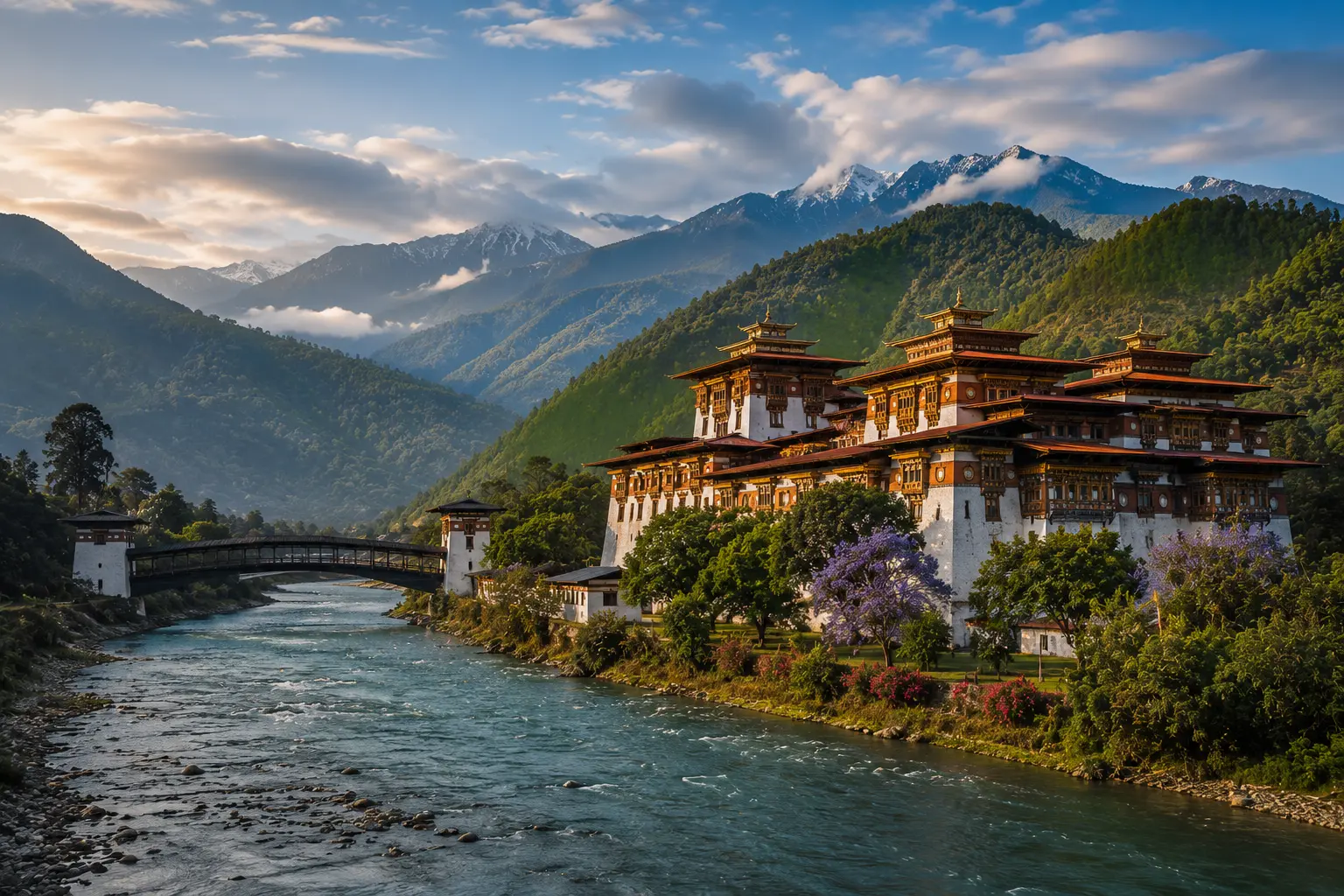
The place
Bhutan sits between Tibet and India and has run its tourism deliberately small since 1974 — a per-night Sustainable Development Fee rather than a cap on visitor numbers, spent on healthcare, education and forest cover.
What that buys you as a traveller is a country with very few tour buses, dzongs still used as working administrative and monastic buildings, and valleys where the built environment is genuinely consistent. What it costs you is that Bhutan is not a cheap trip and cannot be made into one.
The fee is the product. You are paying for a country that has decided not to be crowded.
When to go
March to May and September to November are the two good windows. Autumn gives the clearest mountain views and the biggest festivals; spring gives rhododendron and slightly softer prices.
The monsoon, June to August, means cloud, road slips and frequent Paro flight delays — though the valleys are at their greenest and there is almost nobody around.
December to February is cold and clear, but high passes to central Bhutan can close with snow. Always keep a buffer day before an international connection.
Tap a month for the honest verdict
The daily fee, plainly
The Sustainable Development Fee is charged per person per night: USD 100 for most nationalities, INR 1,200 for Indian nationals and USD 15 for Bangladeshi nationals. Children aged 6–12 pay half and under-6s are exempt. It is separate from your hotel, food, guide and transport.
The government has confirmed USD 100 as the rate until 31 August 2027, so it is stable for now — but it went from USD 65 to 200 to 100 inside two years, so still check the official portal for travel beyond that date. Separately, a 5% GST has applied to tour services (hotels, guides, transport) since 1 January 2026; the SDF and the visa fee are exempt from it.
International visitors must book through a licensed Bhutanese operator before a visa is issued, and a licensed guide is standard outside Thimphu and Paro — required outright on trekking routes.
Two ways to do it
The fast way in, and one of the more dramatic approaches in commercial aviation — Paro is hand-flown between ridges by a small number of certified pilots. Fares are high and fixed; morning flights are less likely to be weather-cancelled.
Tiger's Nest
Paro Taktsang is the one thing every visitor does, and it is a genuine hike: roughly 900 m of ascent over 4–5 hours round trip, with a long staircase down and back up at the end.
Start by 7am to beat both heat and crowds, and put it late in your trip so you've had days to acclimatise. Horses can carry you to the cafeteria halfway; nothing carries you past it. Bags, cameras and phones are left at the entrance to the monastery itself.
Permits, stays and food
Most nationalities get a visa online through the official portal once a booking and the SDF are paid — USD 40, one-time and non-refundable, waived for Indian, Bangladeshi and Maldivian nationals. Indian nationals need a permit and a voter ID or passport rather than a visa. Additional route permits are needed for travel east of Thimphu.
Hotels are graded and licensed, with a wide band from simple three-star to genuinely expensive lodges — the SDF is the same either way. Food is chilli-forward: ema datshi, red rice, buckwheat pancakes in Bumthang, and butter tea you should try once.
Permits & paperwork
What to pack
Layers and a windproof shell — valley days are mild and passes like Dochula are cold and exposed. Broken-in shoes for the Taktsang climb.
Add long trousers and covered shoulders for dzongs and monasteries, sunscreen for high-altitude sun, Indian rupees or USD in cash, and any medication you rely on. Tobacco import is restricted and heavily taxed.
What most people get wrong
Want us to plan your Bhutan trip?
Leave your email and we'll reach out once bookings open.